
For three-quarters of a century following the discovery of superconductivity in 1911, the phenomenon was thought to exist only in metals and alloys at temperatures near absolute zero. This scientific consensus was shattered in 1986 when researchers discovered high-temperature superconductivity (HTS) in a class of ceramic copper oxides. A book dedicated to superconductors oxide explores this monumental paradigm shift, tracking how materials that normally function as insulators can be engineered to conduct electricity with zero resistance at accessible temperatures. A major focus of any text on this subject is the complex structural chemistry of these materials. Unlike simple metals, superconductors oxide are complex multi-element ceramics. Most high-temperature superconductors oxide possess a modified perovskite crystal structure. A textbook on this topic typically dedicates specific chapters to the synthesis and properties of foundational oxide groups. The book details how the physical behaviour of these materials deviates from conventional superconductors. In standard metals, superconductivity is well-explained by the BCS theory, where lattice vibrations (phonons) bind electrons into Cooper pairs. However, in copper oxides, the electron interactions are much more complex. The text addresses theories of strong electron correlation, magnetic fluctuation pairing mechanisms, and the challenges of modeling short coherence lengths within highly anisotropic ceramic layers. The ultimate utility of a book on oxide superconductors lies in its practical engineering perspectives. Because these materials function at liquid nitrogen temperatures, they have unlocked massive scale possibilities. High-efficiency, zero-loss underground power cables and fault current limiters. Medical and Scientific Diagnostics: High-field magnets utilized in advanced MRI machines and particle accelerators. Advanced Electronics: Josephson junctions, ultra-sensitive SQUID magnetometers, and thin-film microelectronics. While mechanical brittleness and weak grain-boundary connections pose manufacturing challenges, continuous innovations in thin-film deposition and tape-processing technology keep superconductors oxide at the absolute frontier of modern quantum engineering.
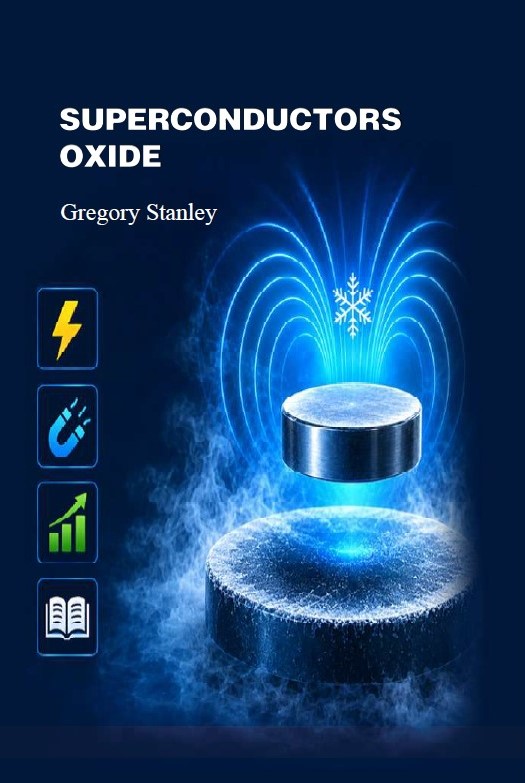
Superconductors Oxide
$125.99
Author Gregory Stanley
Binding Paperback
ISBN 9781995871210
Language English
Pages 290
Subject Category Chemistry
Year of Publication 2027
Related Products
X-ray Crystallography
$125.99
Mesoscopic Chemistry
$125.99
Molecular Electronics
$125.99
Reviews
There are no reviews yet.