
Agricultural land drainage deals with the science, design, and practical management of removing excess surface and subsurface water from farmland. Drainage is a vital branch of agricultural engineering designed to optimize soil moisture, protect crop health, and maintain field accessibility for modern farm operations. Excess water displaces air pockets in soil pores. Lowering the water table restores soil oxygen levels, preventing root suffocation and root rot. In arid and semi-arid irrigated regions, proper drainage flushes out dissolved salts that accumulate in the upper root zone, preventing soil salinization and loss of arable land. Dry soils warm up faster in early spring than waterlogged soils, promoting earlier seed germination. Well-drained fields also support heavy machinery without causing severe soil compaction. Designed for flat areas or heavy clay soils with poor infiltration. Land Smoothing & Grading: Shapes fields to allow smooth runoff toward ditches. Shallow or deep channels collect excess surface runoff during heavy rainfall and direct it safely away from crop fields. Designed to control groundwater levels in permeable or semi-permeable soils. Corrugated Plastic Tubing: Modern systems use flexible, perforated plastic pipes laid underground at calculated depths and slopes. Mole Drainage: Unlined cylindrical channels formed directly in clay subsoils using a specialized mole plow, providing lower-cost short-term relief. Vertical Drainage: Pumping wells extract groundwater directly to lower regional water tables. Bio-Drainage Planting deep-rooted, water-loving trees (such as eucalyptus) to pump out subsurface water naturally through high transpiration rates. Calculating drain spacing and depth relies on soil hydraulic conductivity, water table height, and crop drainage requirements using formulas like Hooghoudt’s or Ernst’s equations. Synthetic geotextiles or gravel envelopes are placed around subsurface pipes to prevent fine soil particles from entering and clogging the lines. Modern drainage installation uses trenchless pipe layers equipped with laser-guided or GPS-RTK grade control to maintain exact pipe slopes. Water-table management systems feature structures that adjust the outlet height, retaining moisture during dry periods and releasing excess water only when necessary. Tile drainage can carry nitrates and agricultural chemicals into surrounding streams. Mitigation strategies include constructed wetlands, bioreactors, and controlled drainage to filter water before discharge. Proper drainage requires significant capital investment, but long-term gains in crop yield, land value, and farming reliability offset initial costs. Agricultural land drainage remains an indispensable practice for sustainable land use, mitigating waterlogging risks and securing global food production in variable climates.
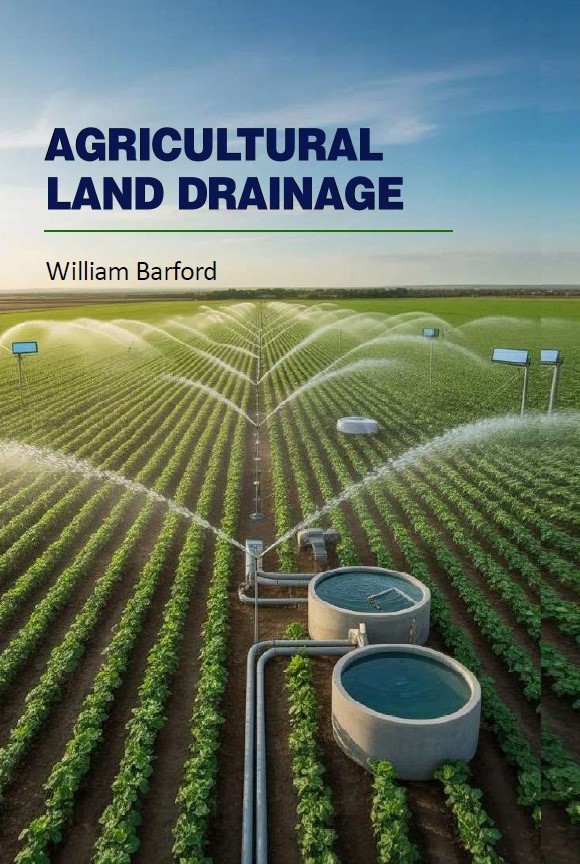
Agricultural Land Drainage
$124.99
Author William Barford
Binding Paperback
ISBN 9781995870022
Language English
Pages 307
Subject Category Agriculture
Year of Publication 2027


Reviews
There are no reviews yet.